- AI with ALLIE
- Posts
- 6 Ways to Work with AI Agents
6 Ways to Work with AI Agents
Here are the protocols you need to actually delegate to them

Allie K. Miller
December 03, 2025

AI with ALLIE
The professional’s guide to quick AI bites for your personal life, work life, and beyond.
TLDR: AI agents need to be told what to do.
And until there are easier ways to get that done (like an AI agent attending and recording your meeting and automatically taking actions afterward...or we all get brain-computer interfaces and become one with the AI), we have to be explicit with how we delegate tasks and pull AI agents into our work as teammates.
I've been talking a lot about how we best do that with agent protocols - the various ways of telling AI agents what to do today. I want to lay them all out and share when I think each works best, so you know when to lean into which mode. Make sure you read to the end or you’ll miss the biggest value.
And send this to your team to level up.
Method 1: Predetermined Automation Workflows
Use this method for both true AI agents (where they reason their own steps) and agentic workflows (where you've prescribed the steps ahead of time, like with Make and Zapier). Best used when you have an explicit, repeated task where you already know the exact steps an AI should take, and you want it automated. For example: every time you send a message to a specific Telegram number, or every time you receive an email with a specific subject line keyword, or every time you receive a new Slack message in a channel, you want XYZ to happen. Often a flowchart interface.

Make (above), Zapier, and n8n are great options for automations. Many of these platforms also have prebuilt automation templates that you can grab with one-click; you just have to connect your apps (like Google Sheets or Telegram) and AI API keys (like OpenAI or Claude).
Method 2: AI Reasoning Through Predetermined Paths
Here, you're still explicitly giving directions, but the AI itself is reasoning which path to take. A prime example is Decagon AI, where human customer support specialists lay out the exact steps a human agent would take in different scenarios so the AI can copy those solutions. Works best when instructions are incredibly clear and rules-based, but the exact path to take might be more flexible, like receiving trouble tickets where you might not know what each one contains. You want an intelligent routing system where you have predetermined steps, but the agent reasons through which of those streets to go down. Decagon calls this an AOP (agent operating procedure) - screenshot below.
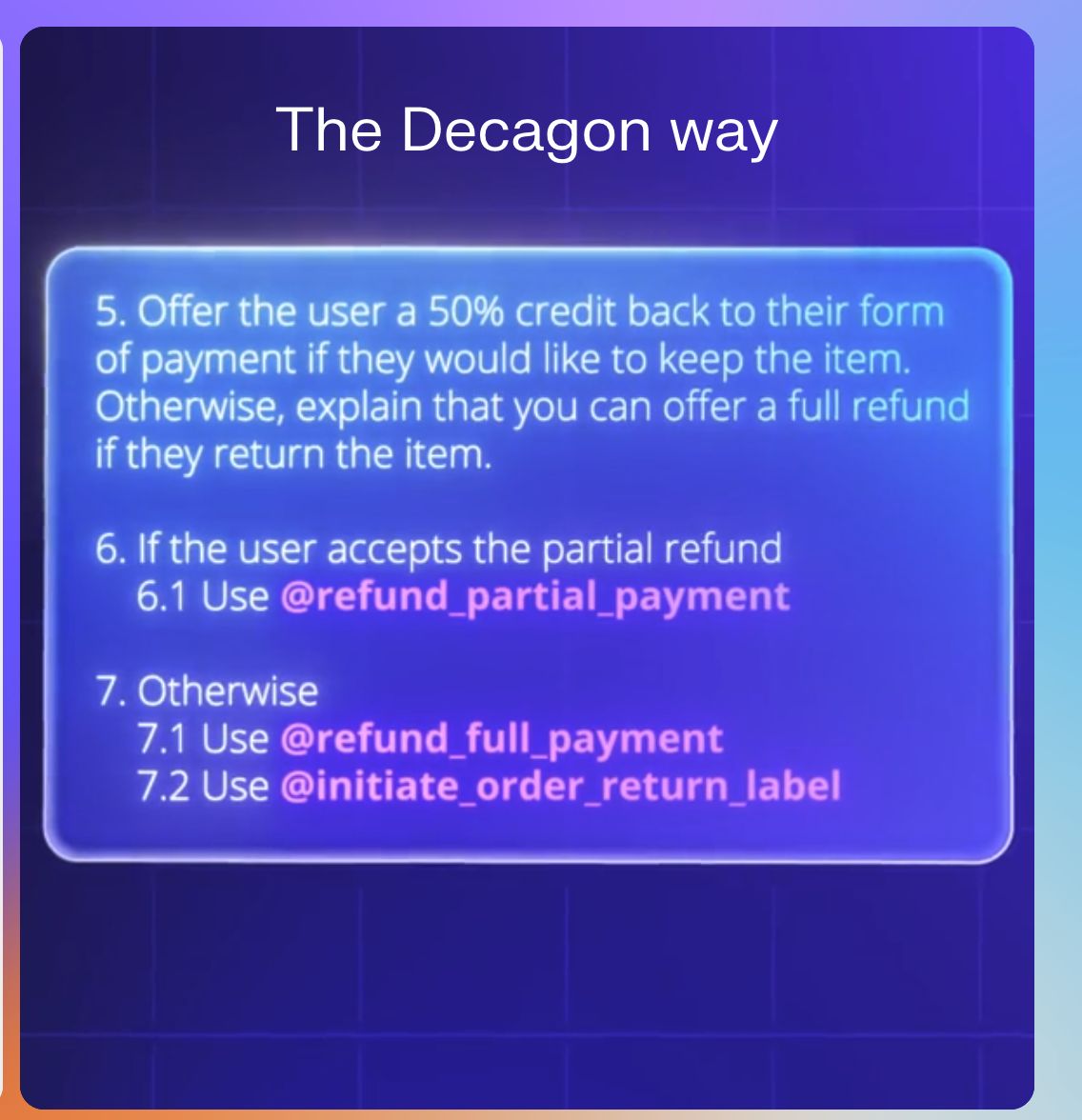
Decagon AI is a popular AI startup worth over $1B and is a leader is AI customer support, in a similar space as Fin AI from Intercom. They have a built-in process for laying out agent protocols. The above screenshot shows off some of that if-then logic.
Method 3: Claude Skills
It’s a zip file with a bunch of directions. Claude Skills requires folder with a ‘SKILL.md’ markdown file - you can also embed references, examples, or even code scripts. Your Claude Skill can be used across all your Claude chats. If your whole team wants to use the same skill, everyone individually will have to add it under Settings > Capabilities. Best used for common workflows that are not trigger-based (like running an automation at a specific time) and that you want to use across any AI assistant interaction. For example, maybe you have a skill to run a specific type of financial analysis on your sales plans - you can use that skill across 30 different sales conversations. Or maybe you have a skill that uses Nano Banana Pro to make images - and you use it to make PPT graphics for the next 3 months. Best for when you want to cut across many chats and best for Claude users. Some of mine are below. Best way to make them? Ask Claude to do it for you!

I used Claude Skills to build out a standardized AI-First Index Assessment tool. This skill allows me to score exactly how AI-First a company is in MINUTES. Over 700 lines of directions and code, include analysis process, examples, templates, and resources. It’s heavenly, truly.
Method 4: Short Prompts for General Agent Platforms
For when you just have a quick one-off ask. Use those method with ChatGPT Agent Mode, ChatGPT Atlas Agent Mode, Manus AI, or Perplexity Comet. Best for simple agent asks—like quickly filling out a form online, or putting together a list of flights for an upcoming trip, or finding a lamp that’s shaped like a leg from A Christmas Story. These are tasks where you don't need to share a ton of varied personal or business context. These workflows can take 15-30 minutes today. I would only offload to a browser agent if: you have a low risk use case and you're testing them out, you want to run multiple tasks at once so slowness doesn't matter, or you want to ditch your computer to grab a meal, go for a walk, or get to sleep.

ChatGPT Atlas is an agentic browser, similar to Perplexity Comet and Manus AI. I often use it for online shopping, product comparisons, trip planning, or complex app management (ex: “go to Synthesia and create a new video for me with a script about taxidermy wolverines and save it to my desktop with the title ‘Hugh Jackman Would Hate This’”)

It’s crazy to me that you can just ask Atlas to complete a whole web task for you. Make it handle your whole Instacart order, make it fill out a long form based on a long dictation, make it reorganize all of your Jira tickets. It feels like that 1940 movie Fantasia, but instead of Mickey Mouse, it’s AI controlling a computer mouse.
Method 5: AGENTS.md Protocol
Instead of writing a short, simple prompt, you're writing a guidebook or playbook for your AI agent. One commonly used format is AGENTS.md, which OpenAI created and feels mostly for coding at this point. Think of it as a README for bots, a dedicated markdown file that provides tailored instructions for AI agents. The protocol has been adopted by over 20,000 open-source repos on GitHub. Key things it includes: dev environment setup, testing instructions, commit/PR guidelines, code style preferences, and security considerations.
Best practices: put commands early, use code examples over explanations, give agents specific personas and boundaries, and, this is my favorite one, group your agent boundaries into 'always do,' 'ask first,' and 'never do.'

Sample Agents.md file - not so dissimilar from the Claude Skill markdown file,
just very very code-y and dev-y. And yes, that is my scientific term for it.
Method 6: My Comprehensive Agent Protocol
As much as I love these other protocols, they’re not full documentation. They’re helpful at describing the task to the AI agent, but not making an action plan for using them. I want you to grab my free protocol template that I've used with clients that solves that. It helps in the obvious way (ie getting together a clear agent plan with KPIs, diagnosing the actual problem, success metrics, and failure planning). But there are sneaky benefits too, maybe even more important than documenting the workflow itself.
It teaches employees how to think about agents and naturally shows them the types of questions and problems to think through.
It orients your AI culture to be problem-first so people aren't giving AI overly risky tasks or skipping important steps.
It builds up a company agent protocol repository. I encourage running an AI agent hackathon with required protocol doc creation to build a library of your most complex workflows across all departments.
My free template is best for line-of-business applications with complex tasks. For simpler things, go with traditional prompts or a simplified version of the playbook.

My favorite part of using the full agent protocol template is using AI to help! Just grab my template, upload it into Copilot, ChatGPT, Claude, or Gemini, and ask for it to interview you until it has 95% of what it needs to complete the document. Dictate your responses for max speed and ease. Do it while sipping on a marg, I don’t care.
How to Document Processes
The thorn that every business unfortunately has to deal with is that the people most knowledgeable about processes tend to also be the busiest. You want the experts on this and can't afford to have them punt it to teammates. Some ways to solve this:
Dedicated meeting blocks: Schedule 30-60 minute sessions specifically for process documentation—treat it like any other important meeting.
Targeted agent hackathons: Run agent hackathons (must include training and prizes!) that require teams to fill out protocol documents as part of the submission.
Monthly business reviews: Add a standing agenda item where teams present one documented process and make it required.
Record and transcribe with Loom/Otter/Zoom/Teams: Have experts walk through processes verbally while recording—then use AI to turn the transcript into documentation with a SOTA model (ex: Claude Opus 4.5, GPT-5.1 with Thinking).
Shadow and document: Assign a junior team member or operations person to shadow experts and capture their workflows.
LOOKING AHEAD
Some things you'll likely hear more about (from me and the interwebs) include: specifying value functions or win functions or reward functions to AI systems, more live interaction modes wherever we work (ex: in meetings, in Slack, on assembly lines), and native agent integration via AI-first devices or brain-computer interfaces. All of these options would make protocols easier to write, easier for the agent to intuit, or render them unnecessary. And boy, that day will come. But that day is not today. As with life, we’re not waiting for the perfect moment. You can't put your career on hold waiting for extreme convenience. When you endure a little inconvenience, you gain an unfair advantage. Right? You have to deal with the medium friction we have today and come up with a standardized way of educating your company on how to tell agents what to do in a way that maintains your core org principles, increases business value, and empowers your employees and leaders. I hope you steal these methods, and use your new agent playbook to conquer the world. Or at least your next workflow.
As always: stay curious, stay informed,
Allie
⚡ LAST CHANCE: CYBER WEEK SALE ⚡
Get up to 55% Off the AI-First Academy

Ends tonight at midnight.
Purchase 2+ seats and save up to 55% - the more seats, the deeper the discount. I know thousands of you have a learning budget that is expiring in just a few weeks or you’ve got a team that needs immediate AI fluency before Q1. This sale is for you - and you have until midnight ET tonight.
The AI-First Academy is 4+ hours of virtual hands-on training across four progressive tracks—from AI Basics to Advanced. And best yet, you can move entirely at your own pace.
Your team will learn how to:
✔ Build custom GPTs and reusable AI workflows
✔ Automate reports, research, and meeting synthesis
✔ Prototype AI-powered tools—no coding required
✔ Leverage the best of today’s AI agents - including Claude Skills, ChatGPT Atlas, and ChatGPT Agent mode - with instant access to the 90-minute Agentic AI Workshop (just added last week)
Q1 is four weeks away, but the discount ends at midnight ET. Get your team upskilled before it's gone.
Learn more AI through Allie’s socials